Changes in IgG glycosylation of primary Sjögren’s syndrome is detected by LCA lectin

A group from Key Laboratory of Rheumatology & Clinical Immunology, Ministry of Education, Beijing, China, etc. has reported about changes in IgG glycosylation of primary Sjögren’s syndrome.
https://www.ncbi.nlm.nih.gov/pmc/articles/PMC9961092/

Primary Sjögren’s syndrome (PSS) is a systemic autoimmune disease resulting in significant loss of systemic gland secretory function.

Total of 128 serum samples were used for lectin microarray analysis, obtained from 40 PSS patients), 50 primary biliary cholangitis (PBC) patients, and 38 healthy controls who were healthy volunteers.

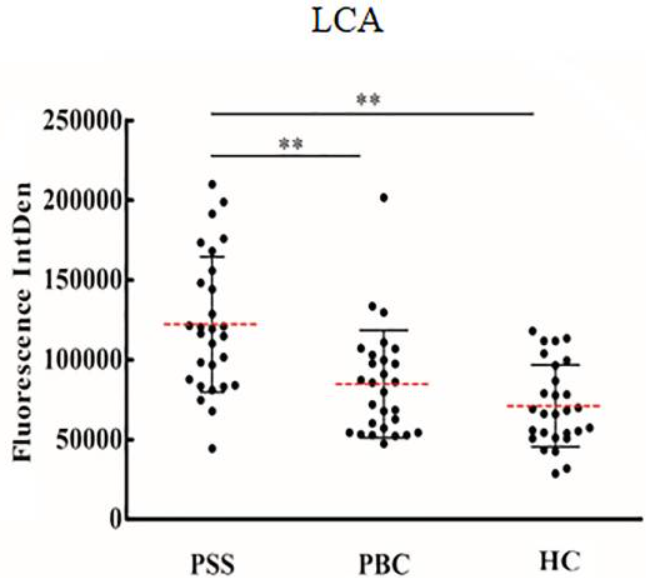
As a result, it was found that changes in serum IgG glycosylation in PSS increased binding levels of LCA lectin compared to healthy controls and PBC patients.

5 kinds of diagnostic O-glycoprotein biomarkers for advanced colorectal cancer

A group from Graduate School of Medical Life Science, Yokohama City University, Yokohama, Japan, etc. has reported about diagnostic biomarkers for advanced colorectal cancer (CRC).
https://www.ncbi.nlm.nih.gov/pmc/articles/PMC9948623/

O-glycoproteins in serum samples collected from CRC patients were enriched by using lectin affinity purification using MPL, Jacalin, and SNL, as biomarker candidates, and analyzed by LC-MS/MS in detail.

It was found that the followings can have high diagnostic efficacy to strategically predict advanced CRC groups.

  • fibulin-2 (FBLN2) /T antigen
  • macrophage colony-stimulating factor 1 (CSF1)/(T + di-Sialyl T)
  • macrophage mannose receptor 1 (MRC1) /T
  • fibrinogen alpha chain (FGA)/Sialyl T
  • complement component C7 (C7) /di-Sialyl T

Structural and functional analysis of BK polyomavirus mutants regarding the infectivity

A group from Nantes Université, CHU Nantes, INSERM, Center for Research in Transplantation and Translational Immunology, France, etc. has reported about structural and functional analysis of BK polyomavirus mutants regarding the infectivity.
https://pubmed.ncbi.nlm.nih.gov/36790933/

BK polyomavirus (BKPyV) is a small, non-enveloped, double-stranded DNA virus with an icosahedral capsid formed by 72 capsomers, where a capsomer is an association of a pentamer of the VP1 protein. BKPyV is known to interact with the urothelium and kidney epithelium through the gangliosides GT1b and GD1b, but also via other b-series gangliosides characterized by their α2-8-linked-disialyl moieties attached to the first galactose from the reducing end. BKPyV is an opportunistic virus with a prevalence of 80% in the worldwide population. Usually, infections occur asymptomatically during childhood and then lead to latency or persistence in the kidneys.

In this study, four variant forms of the VP1 protein were discussed. These variants had accumulated multiple mutations in the BC loop region of the VP1 protein, which is involved in the direct interaction of the virus with sialic acids. Those variants contained double mutant K69N E82Q (N-Q), E73Q mutant, E73A mutant, and triple mutant A72V E73Q E82Q (VQQ). Cell lines 293TT and RS were used to test the infectivity of all variant pseudoviruses as well as wild-type (WT) subtype Ib2 pseudovirus. Both cell lines were shown to contain monosialylated GM2 and GM3 a-series gangliosides along with neutral globosides from the structural studies using MS. In addition, RS cells specifically expressed b-series disialylated gangliosides GD2 and GD3 carrying α2-8-linked-disialyl epitopes.

The followings were found.
The N-Q variant lost all ganglioside-binding activity but retained infectivity in 293TT cells through a sialic acid-independent pathway, whereas VQQ showed enhanced ganglioside binding but almost completely lost infectivity in 293TT cells. One plausible explanation of these observations is that the VQQ variant may have lost the ability to interact with the unknown entry receptor employed by the N-Q variant to infect 293TT cells, and that this interaction is required, in addition to sialic acid binding, for infectious entry.

FUT8 is upregulated under oxidative stress

A group from Department of Applied Chemistry and Biotechnology, Faculty of Engineering, Okayama University, Okayama, Japan, etc. has reported that FUT8 is upregulated under oxidative stress.
https://journals.plos.org/plosone/article?id=10.1371/journal.pone.0281516

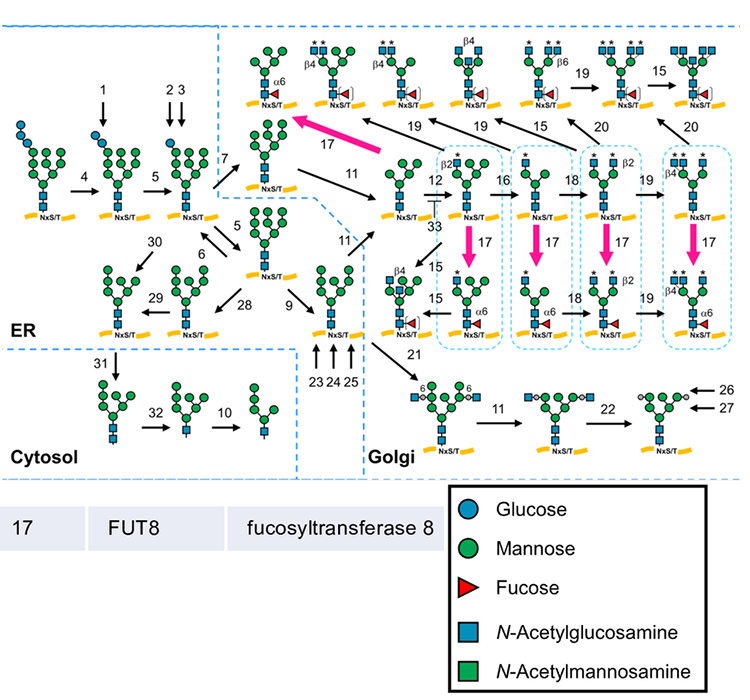
The antioxidant response as defined by the Gene Ontology category includes 441 human genes, such as HMOX1 (Heme oxygenase 1) and GCLC (Glutamate—cysteine ligase catalytic subunit), which are typical antioxidant response genes. The expression of these genes helps reduce the oxidative condition in cells to protect them from oxidative stress. To test whether there is any changes in glycan expressions due to antioxidant responses, gene expressions in human keratinocyte cell line HaCaT were investigated with or without 5-hydroxy-4-phenyl-butenolide (5H4PB) and sulforaphane (SFN), which has been known to be an antioxidant.

It was found that FUT8 is upregulated in both cases (5H4PB and SFN) from gene analysis. This was also confirmed by flow cytometry using fluorescein-conjugated fucose binding lectin, UEA-I.

Fucoidan reduces the proportion of Pseudomonas aeruginosa in the intestinal microbiota and improves immunity

A group from Molecular Infectious Disease Research Center, Chang Gung Memorial Hospital, Taoyuan, Taiwan, etc. has reported that focoidans mediate decolonization of Pseudomonas aeruginosa from gut by inhibiting secreted virulence factor interactions with mucins and enriching Bacteroides population.
https://www.ncbi.nlm.nih.gov/pmc/articles/PMC9896862/

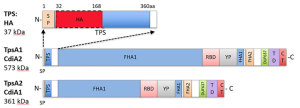
Pseudomonas aeruginosa intestinal carriage rates are significantly higher in immunosuppressed individuals and hospitalized patients who therefore have increased risk of infections and antibiotic-associated diarrhea. Although gut microbiota acts as a barrier against intestinal pathogens, P. aeruginosa overcomes the resistance to colonization mediated by gut microbiota and innate immune system, by producing an impressive array of virulence factors. P. aeruginosa carries large protein systems that belong to two-partner secretion (TPS) family, and there is a conserved hemagglutinin (HA) domain in this TPS. The TPS system effectors are designated as major virulence determinants that are beneficial to Gram-negative pathogens (Pseudomonas is a Gram-negative).

Nutritional grade fucoidans 0.5% (w/v), from Fucus vesiculosus (FV) and Ascophyllum nodusum (AN), were supplemented in the drinking water of mice for 19 days. Among the mice that were fed with fucoidans for 14 days p.i., two patterns of decolonization were observed: (1) P. aeruginosa was eliminated from a higher proportion of the mice with time, (2) but in the remaining mice P. aeruginosa persisted throughout the study period but with declining bacterial loads over time. Of note, between p.i. day 15 and day 30 among the fucoidan fed groups proportion of the mice that were decolonized further increased to 60% (P < 0.05). It was found that there are two mechanisms by which fucoidans mediate their protective effects: first, inhibition of virulence factors TPS interactions with mucins and second, selectively promoting the growth of beneficial Bacteroides species. IC50s of interaction between TPS and intestinal mucins by FV fucoidan and AN fucoidan were less than 1 μg/mL.

Glycan modification is different spatiotemporaly in cardiac tissues

A group from Research Team for Geriatric Medicine (Vascular Medicine), Tokyo Metropolitan Institute of Gerontology, Tokyo, Japan. etc. has reported about spatiotemporal changes of tissue glycans depending on localization in cardiac aging.
https://www.ncbi.nlm.nih.gov/pmc/articles/PMC9841240/

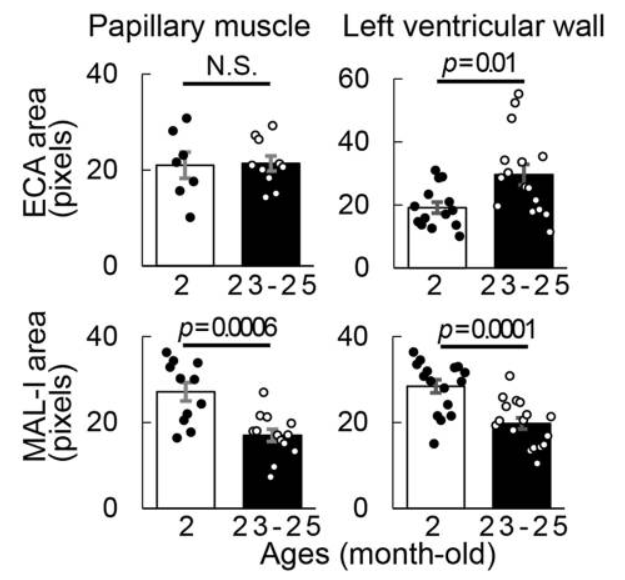
To investigate the characteristics of glycans in mouse cardiac tissues, eight parts of the short-axis slices from normal female mouse hearts, including the left ventricular wall (ventral sides and dorsal sides), the papillary muscle, and the ventricular septum were analyzed for three age groups (2 months, 12–14 months, and 23–25 months) using the lectin microarray.

The glycan profiles of the eight areas of the hearts of 2-month-old mice were analyzed in detail using PCA. Interestingly, it was fond that glycan profiles differ in each region of the cardiac tissue. For instance, papillary muscle and ventricular septum were characterized by sialic acid residues, and ventral left ventricular wall were characterized by O-glycan residues and large-branched and asialo N-glycan residues.

It was also found that sialic acid resides decreases with aging, although the rate of change varied from area to area.

Changes in glycosylation of B cells and T cells in systemic lupus erythematosus patients

A group from Departamento de Medicina y Zootecnia de Cerdos, Universidad Nacional Autónoma de México, Ciudad de México, Mexico, etc. has reported about changes in glycosylation of B cells and T cells in systemic lupus erythematosus (SLE) patients.
https://www.ncbi.nlm.nih.gov/pmc/articles/PMC9820943/

Systemic lupus erythematosus (SLE) is an autoimmune disease that can affect every organ and system in the body.

In the case of B cells, glycosylation studies have been directed primarily at immunoglobulins. SLE patients have alterations in the glycosylation of immunoglobulin G. A greater recognition of the AAL lectin, which has an affinity for fucosylated residues, has been observed in comparison with healthy individuals. Increased recognition of the LCA lectin, which is specific for the core fucosylated trimannose N-glycan, towards immunoglobulin G has been also reported in SLE patients. Using ultra-resolution liquid chromatography, it was also found that they present a decrease in IgG galactosylation and sialylation.

It has been shown that T cells from SLE patients present alterations in O-glycosylation using the ALL lectin, which recognizes core 1 in coactivating T cell receptors. T cells from patients with active SLE had less recognition by ALL than those with inactive SLE, and expression of receptors recognized by ALL was inversely correlated with disease activity. Another study reported increased expression of Tn antigen-type O-glycans in T cells from SLE patients using VVA lectin.

A decrease in O-GlcNAcylation and phosphorylation of E74-like factor 1 (ELF-1) has been observed in SLE patients.

Characterization of N-glycoproteins from human tear films

A group from Department of Experimental and Translational Ophthalmology, University Medical Center, Johannes Gutenberg University, Mainz, Germany has reported about characterization of N-glycoproteins from human tear films.
https://pubmed.ncbi.nlm.nih.gov/36677706/

The main objective of this study was to develop a lectin-based affinity purification method for the enrichment of glycoproteins/glycopeptides from human tear film and the MS-based detection as well as localization of their specific N-glycosylation sites.

The best-performing multi-lectin column system (comprising the four lectins ConA, JAC, WGA, and UEA I, termed 4L) was applied to glycopeptide enrichment from human tear sample digests. As the main result, a total of 26 N glycosylation sites of 11 N-glycoproteins (LIF, PIGR, IGHA2, IGHA1, AZGP1, LACRT, JCHAIN, PIP, TF, HP, and SERPINA1) was identified in the tear sample pools of healthy individuals.

This result will serve as an important N-glycoprotein reference map for future studies focusing on the ocular surface and will help to unravel the complex regulatory functions of N-glycoproteins in maintaining tear film stability and the ocular defense system.

Characterization of Rotavirus A isolated from bat and rodent hosts

A group from Division of Molecular Pathobiology, International Institute for Zoonosis Control, Hokkaido University, Sapporo, Japan, etc. has reported about isolation and characterization of distinct Rotavirus A (RVA) in bat and rodent hosts.
https://pubmed.ncbi.nlm.nih.gov/36633410/

Here, RVA was isolated from Egyptian fruit bat and Natal multimammate mouse collected in Zambia (representative strains: 16-06 and MpR12).
The RVA genome consists of 11 dsRNA segments, each encoding 6 structural viral proteins (VPs) and 5 or 6 nonstructural proteins (NSPs). RVA has a nonenveloped, triple-layered virion, with the outer capsid layer consisting of the spike protein VP4 and the glycoprotein VP7.

It was found that 16-06 entered cells by binding to sialic acids on the cell surface, while MpR12 entered in a sialic acid-independent manner. Notably, glycan-binding analysis suggested that 16-06 recognizes both human and animal-type sialic acid, NeuAc and NeuGc.

Rice phyllosphere microbiome: Differences in microbial communities between wild and cultivated rice

A group from State Key Lab of Urban and Regional Ecology, Research Center for Eco-Environmental Sciences, Chinese Academy of Sciences, Beijing, China, etc., has reported about differences in microbial communities between wild and cultivated Rice.
https://pubmed.ncbi.nlm.nih.gov/36625666/

The core rice phyllosphere bacteria contained 27 Proteobacteria that made up 62.8% of relative abundance, and Pantoea was the most abundant genus (42.7%), followed by Methylobacterium (4.8%), Pseudomonas (3.6%), Acinetobacter (2.9%), and Serratia (2.1%). Except for Proteobacteria, Actinobacteriota (11.7%), Firmicutes (8.5%), and Bacteroidota (0.5%) were the abundant phyla of the core phyllosphere bacteria. As for fungi, 29 core fungal ASVs were mainly classified in the genera of Nigrospora (13.2%), Pyrenophora (13.1%), Papiliotrema (12.5%), and Phaeosphaeria (4.5%). Although the core taxa were present in all the samples, the relative abundance of these ASVs varied significantly across rice species and sampling sites.

For bacteria, Xanthomonas, Klebsiella and Sphingomonas were mostly enriched in the wild rice. Meanwhile, there were some core bacteria significantly enriched in the wild rice, such as Methylobacterium, Xanthomonas, Hymenobacter, and Klebsiella. Compared to the cultivated rice, Methylobacterium was the most enriched genus in wild rice. For fungi, Khuskia, Acidomyces, and Pyrenophora were mostly enriched in the wild rice, while none of core fungal taxa were enriched in the wild rice. Compared to the wild rice, Pseudomonas and Comamonas were the main enriched bacterial genera in the cultivated rice, and Chaetomium, and Rhodotorula were the main enriched fungal genera in the cultivated rice, respectively.

From a view point of functional profiles of the rice phyllosphere microbiome, significantly higher functional potentials of methanol oxidation (+594%), methylotrophy (+460%), ureolysis (+430%), and photoheterotrophy (+345%) were expected in wild rice than in cultivated rice (P < 0.05) (Fig. S5C). In addition, cultivated rice had significantly higher potentials of plant pathogens (+91%), human-associated (+88%) and human pathogens (+88%).
Powered by WordPress |Copyright © 2020 Emukk. All rights reserved