Aberrant glycosylation in serum glycoproteins observed in patients with Hashimoto’s thyroiditis

A group from Department of Laboratory Medicine, Shengjing Hospital of China Medical University, Shenyang, China, etc. has reported about aberrant glycosylation observed in Hashimoto’s thyroiditis.
https://www.ncbi.nlm.nih.gov/pmc/articles/PMC10348014/

Hashimoto’s thyroiditis (HT) is the most common autoimmune thyroid disorder and is characterized by lymphocyte infiltration of the parenchyma and the presence of antibodies specific to thyroid antigens.
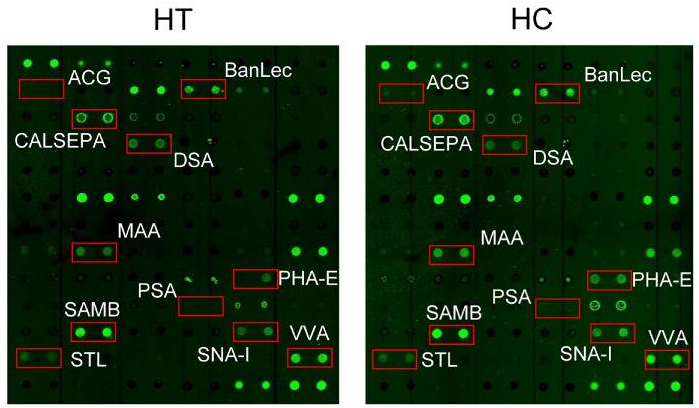
In this study, a total of 53 serum samples collected from 27 patients with HT and 26 healthy controls (HCs) were used for lectin microarray analysis, and it was found that the majority of the lectin binding signals in HT group were weakened compared with the HC group, while the Vicia villosa agglutinin (VVA) binding signal was increased.


Mx thinks that the quality of lectin microarrays used was not GOOD enough.

KLF12/Gal-1 axis may serve as a novel cancer therapeutic target for patients with immunotherapy resistance

A group from Department of Thoracic Surgery, Chinese Academy of Medical Sciences and Peking Union Medical College, Beijing, China, etc. has reported that KLF12/Gal-1 axis may serve as a novel cancer therapeutic target for patients with immunotherapy resistance.
https://www.ncbi.nlm.nih.gov/pmc/articles/PMC10432659/

In this study, it was demonstrated that the decline in KLF12 in tumor cells is an important mechanism for immune escape, leading to resistance to anti-PD-1 therapy. Mechanistically, KLF12 could directly bind to the promoter region of Gal-1 and inhibit its expression, and thereby promotes CD8+ T cell infiltration into the tumor microenvironment and kills tumore cells.

Continued research into the mechanisms of action of KLF12 and a new combination immunotherapy for circumventing drug resistance may provide more effective treatment options for patients with cancer.

Methanotrophic bacteria can reducing greenhouse gas emissions and promote plant growth at the same time

A group from Institute for Water Research and Department of Microbiology, University of Granada, 18071 Granada, Spain, etc. has reported that methanotrophic bacteria can reducing greenhouse gas emissions and promote plant growth at the same time.
https://www.ncbi.nlm.nih.gov/pmc/articles/PMC10347144/

Although carbon dioxide (CO2) receives the most attention as a global warming factor, there are other gases to consider, for instance methane (CH4). It is thought that methane is the cause of at least one-fourth of the current gross warming. Atmospheric concentrations of methane are rising rapidly, principally due to anthropogenic contributions, with wastewater treatment facilities, landfills, and livestock considered to be the key producers. The removal of atmospheric methane is needed to offset the steady release of methane, thereby limiting the contribution of this potent greenhouse gas to climate change.

This paper explores the potential of methanotrophic bacteria as plant-growth-promoting rhizobacteria (PGPR) to save plants from droughts and also to reduce greenhouse gas, methain, at the same time. Since methane oxidation leads to water production as a byproduct (i.e., CH4 + O2 = [CH2O] + H2O), it was thought that methane-consuming microbes produce water intracellularly and are capable of surviving with a limited external water supply, releasing excess water into its environment.
Actually, the highest values of relative humidity in vermiculite used as a soil were detected in some methanotrophic innoculated samples, with values of 72.29 ~ 62.26%. It is noteworthy that in the absence of methane, its relative humidity was drastically reduced by almost half. These results suggest that the methanotrophic bacteria could efficiently preserve water using methane-derived metabolic water. And interestingly, the PGPR effect was maximized with the same methanotrophic bacteria, which can help water preservation, at the same time.
Aberrant serum protein N-glycome patterns with endometrial cancer

A group from Medical Research Center, State Key Laboratory of Complex Severe and Rare Diseases, Peking Union Medical College Hospital, Chinese Academy of Medical Sciences and Peking Union Medical College, Beijing, China, etc. has reported about aberrant serum protein N-glycome patterns with endometrial cancer (EC).
https://www.ncbi.nlm.nih.gov/pmc/articles/PMC10331720/

In this paper, serum N-glycome patterns of endometrial cancer (EC) were investigated using MALDI-TOF-MS to identify candidate biomarkers.

As a result, the following changes in glycosylation were identified.
(1) The ratio of high-mannose to hybrid glycans increased greatly in EC compared with controls.
(2) The fucosylation decreased significantly in EC.
(3) The sialylation in bi-antennary and tri-antennary glycans increased significantly in EC than in controls, mainly due to the increase of α2,6-linked glycan species.

Gal-3+ Macrophages and Osteopontin are upregulated in skeletal muscle fibrosis

A group from Department of Physiology and Biophysics, University of California Irvine, Irvine, CA, USA, etc. has reported about an unique macrophage population associated with skeletal muscle fibrosis.
https://www.ncbi.nlm.nih.gov/pmc/articles/PMC10328414/

Macrophages have a central role in innate immunity and contribute to tissue homeostasis by regulating tissue repair and remodeling of the extracellular matrix. There are two types of macrophagese, M1 and M2. In acute muscle trauma, proinflammatory M1 macrophages initially infiltrate injured muscle to phagocytose cellular debris and activate muscle stem cells. The subsequent transition to M2 macrophages in the regenerative phase promotes muscle stem cell differentiation and the resolution of inflammation.

In the case of skelectal muscle fibrosis, it was found that gal-3+ macrophages are are chronically activated during muscular dystrophy. Spatial transcriptomic analysis of dystrophic muscle revealed that areas enriched in gal-3+ macrophages and stromal cells expressed genes associated with muscle fibrosis. Furthermore, gal-3+ macrophages colocalize with stromal cells in dystrophic lesions, and osteopontin (Spp1) mediates communication between these cell types.

O-glycosylation of PD-1 expressed on T-cells

A group from Translational Research Unit, Chulabhorn Research Institute, Bangkok, Thailand, etc. has reported about O-glycosylation of PD-1.
https://www.nature.com/articles/s41598-023-36203-3#Abs1

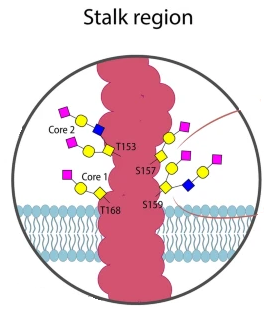
It was found that the stalk region of PD-1 at T153, S157, S159, and T168 are modified by sialylated O-glycan with core 1–and core 2–based structures.
The most likely function of these modifications would forming a rod-like structure and stretching the receptor on the cell surface with the steric interaction between O-glycans and the peptide backbone in the stalk region.

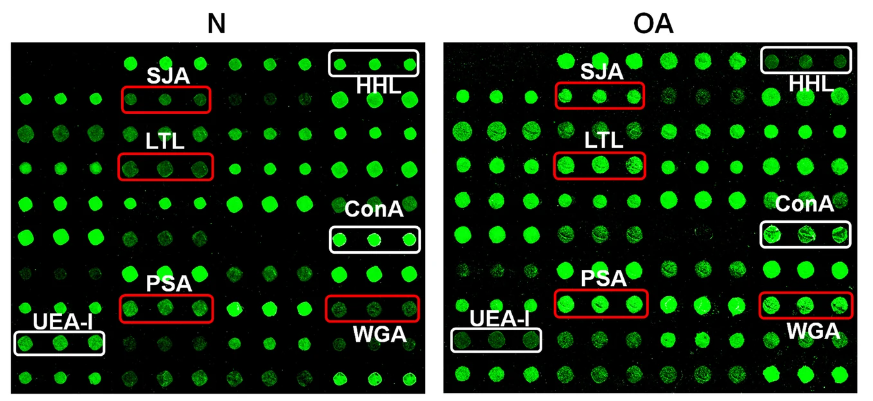
Aberrant glycosylation associated with osteoarthritis (OA)

A group from Laboratory for Functional Glycomics, College of Life Sciences, Northwest University, Xi’an, China, etc. has reported about aberrant glycosylation associated with osteoarthritis (OA).
https://arthritis-research.biomedcentral.com/articles/10.1186/s13075-023-03084-w

The abnormal glycopatterns and heterogeneities of site-specific glycosylation associated with Osteoarthritis (OA) were investigated by using Lectin microarrays and LC-MS/MS.
It was found that abnormal glycosylation, including a high level of α-1,3/6 fucosylation and low level of high-mannose type N-glycan, was obsedeved in OA cartilages.

Heterogeneities of glycoforms on Fibronectin(FN1) and Aggrecan core protein (ACAN) were new features of OA cartilage. These proteins were mainly localized in the extracellular region and extracellular space.
In detail, as for Fibronectin(FN1)-N528, N4H5S2 almost disappered and N4H4F1S1 greatly increased,
as for Aggrecan core protein (ACAN)-N333, N5H8F1 almost disappered and N6H4S1, N4H3F1, N5H3F1, N2H5, N6H4 significantly increased,
and as for Aggrecan core protein (ACAN)-N658, N5H4F1S2, N6H6F1, N6H7, N7H6 almost disappered and N2H11 significantly increased.

Human milk is very effective in protecting preterm infants from necrotizing enterocolitis

A group from USDA Children’s Nutrition Research Center, Department of Pediatrics, Baylor College of Medicine, Houston, TX 77030, USA, etc. has reported that pre- and probiotics are not sufficient for protection from Necrotizing enterocolitis (NEC) in an exclusively formula-based diet.
https://www.ncbi.nlm.nih.gov/pmc/articles/PMC10255242/

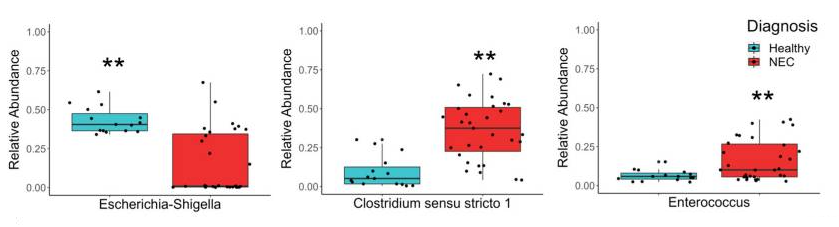
NEC is the leading cause of death resulting from gastrointestinal disease in premature infants, with a mortality rate of 15–40%. It was found about intestinal bacteria that (1)Escherichia-Shigella is Significantly more abundant in healthy piglets and negatively correlates with disease severity, (2) Clostridium sensu stricto 1 and Enterococcus are significantly more abundant in the colon of diseased piglets and correlates with disease severity (see below).

Although dietary probiotic Bifidobacterium longum subsp. infantis (BL. infantis) and sialylactose (3′SL) supplementation had no effect, donor human milk (DHM) significantly reduced the incidence of NEC.

Changes in complement component C3 glycosylation in type 1 diabetes complications

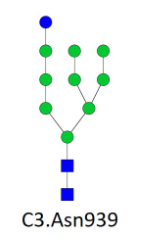
A group from Faculty of Pharmacy and Biochemistry, University of Zagreb, Zagreb, Croatia, etc. has reported about a new biomarker (c3.Asn939-N2H10) for type 1 diabetes (T1D) complications.
https://www.frontiersin.org/articles/10.3389/fendo.2023.1101154/full

N-glycan profiles of complement component C3 have been profiled in 189 T1D subjects with different status of complication severity. The analysis was conducted by high-mannose glycoprotein enrichment from human blood serum using Con A lectin matrix, Glu-C digestion, glycopeptide purification and subsequent nano-LC-ESI-MS technique.

It was found that only one glycoform, C3.Asn939-N2H10, significantly changed in albuminuria and retinopathy, and also there was the biggest correlation between C3.Asn939-N2H10 and HbA1c.

Alterations in the Glycan modification of Serum Glycoproteins in Attention-Deficit Hyperactivity Disorder (ADHD)

A group from Institute of Chemistry, Slovak Academy of Sciences, SK-84538 Bratislava, Slovakia, etc. has reported about alterations in the Glycan modification of Serum Glycoproteins in Attention-Deficit Hyperactivity Disorder (ADHD).
https://www.ncbi.nlm.nih.gov/pmc/articles/PMC10218324/

This study is focusing on determining whether serum glycan analysis holds the potential to identify novel ADHD biomarkers based on changes in glycosylation. They applied combined glycan analysis using two different techniques, lectin microarray and MALDI-TOF MS methods.

As a result, it was found that antennary fucosylation increases, di-/triantennary N-glycans with bisecting GlcNAc and α2-3 sialylation decrease in ADHD.

Powered by WordPress |Copyright © 2020 Emukk. All rights reserved