blog

Wheat rhizospheric microbiome: from Phylum level analysis and Genus level analysis

A group from ICAR-Indian Institute of Wheat and Barley Research, Karnal, Haryana, India, etc. has reported about wheat microbiome under varied agricultural field conditions.
https://pubmed.ncbi.nlm.nih.gov/36445165/

This report presents wheat microbiome analysis under six different farm practices,
organic (Org),
timely sown (TS),
wheat after pulse crop (WAPC),
temperature-controlled phenotyping facility (TCPF),
maize-wheat cropping system (MW), and
residue burnt field (Bur).

The analysis based on phylum level revealed abundances of Proteobacteria, followed by Actinobacteria, Acidobacteria, Gemmatimonadetes, and Bacteroidetes, in all conditions, while the relative abundances varied at the genus level. The highest relative abundances of the genera Bacillus and Flavobacterium were observed in TCPF and Org, respectively, and the genus Nitrospira had the highest relative abundance in TS, MW, and WAPC.

Seed priming of entomopathogenic fungi to increase maize crop growth and tolerance against herbivores

A group from State Key Laboratory for Biology of Plant Diseases and Insect Pest, Institute of Plant Protection, Chinese Academy of Agricultural Sciences, Beijing, China, etc. has reported seed priming of entomopathogenic fungi to increase crop growth and tolerance against herbivores.
https://bmcplantbiol.biomedcentral.com/articles/10.1186/s12870-022-03949-3

Ostrinia furnacalis is the most destructive pest of maize causing an annual yield loss of about 6 to 9 million tons in East and Southeast Asia.

Seed priming is nowadays considered one the most promising techniques in enhancing abiotic and biotic stress tolerance, yield, and growth in crop plants. In this study, seed priming using Beauveria bassiana (BB) and Trichoderma asperellum (TA) were evaluated.

From the experimental results, the additional yield and gross return were calculated to estimate the increase in corn yield and economic return by the seed priming of entomopathogenic fungi. The highest additional yield of 6811.62 KG/ha and 8117.45 KG/ha in year 2018 and 2019 respectively was recorded in consortium treatment (BT), which is an increase of 82 – 96% over control. Treatment by BB and TA resulted in additional yield of 4518.06 (52.2%) and 2930.19 (35.4%) respectively in 2018 year and 4688.58 (55.8%) and 3982.40 (47.5%) in 2019 over control.

The effect of seed priming of entomopathogenic fungi was seen in O. furnacalis larval development, especially in consortium inoculated plants (BT). The growth speed was greatly reduced and larval survival rate was also reduced. It was seen that more then 50% larvae cannot even reached at 3rd instar stage and died. The lowest survival rate of 13% was recorded in consortium (BT) treated plants followed by 28% in B. bassiana (BB) and 36% in T. asperellum (TA) was recorded whereas the survival rate in control group was 94%.

Leaf samples of seed primed and non-primed maize under O. furnacalis stress were analyzed for antioxidants, proline, and chlorophyll content. Seed priming with fungal strains significantly increased the enzyme activities at 24-h by the consortium treatment (BT) compared to non-primed control (IC). The seed priming with BT significantly enhanced the SOD, POD, Protease, PPO, and Proline activities up to 80.29-, 336-, 302-, 141-, and 65.8-fold respectively. And further, O. furnacalis infestation significantly increased cis-OPDA, JA, and JA-Ile in all fungal inoculated treatments (BB, TA, BT) but the highest phytohormone content was observed in consortium treated plants (BT), suggesting that the entomopathogenic fungal inoculation., especially consortium (BT) induced the enhanced production of JA metabolites in maize.
Foliar pathogen infection recruits beneficial bacteria through root exudates

A group from State Key Laboratory for Conservation and Utilization of Bio-Resources in Yunnan, Yunnan Agricultural University, Kunming, China, etc. has reported that foliar pathogen infection recruits beneficial bacteria through root exudates.
https://pubmed.ncbi.nlm.nih.gov/36445116/

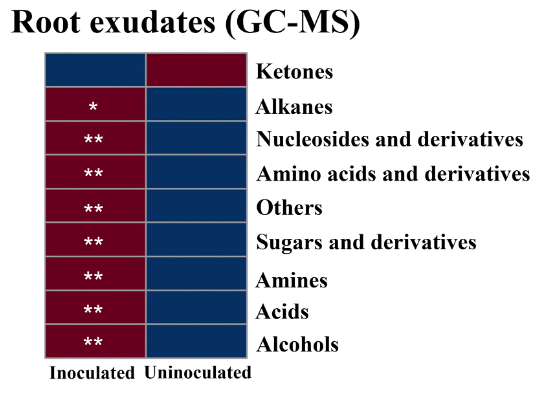
It was found that foliar infection of Panax notoginseng by Alternaria panax modified the rhizosphere soil microbial community and reversed the direction of the buildup of the soilborne pathogen Ilyonectria destructans and beneficial microbes, including Trichoderma, Bacillus, and Streptomyces, in rhizosphere soil. These beneficial microbes not only showed antagonistic ability against the pathogen I. destructans but also enhanced the resistance of plants to A. panax.


Foliar infection changes the metabolite profiles of root exudates determined by GC-MS analyses. Inoculated means foliar infection.

This is similar to the human immune response, in which cytokines and chemokines are secreted from the inflammatory site, and immune cells such as leukocytes are attracted to the inflammatory site. Changes in the secretion from the root correspond to the secretion of cytokines and chemokines, and beneficial bacteria are immune cells derived from bone marrow cells.

Lectin analysis of SARS-CoV-2-positive nasopharyngeal samples

A group from GLYcoDiag, 2 Rue du Cristal, Orléans, France, etc. has reported about lectin analysis of SARS-CoV-2-positive nasopharyngeal samples.
https://www.mdpi.com/2075-4418/12/11/2860

I have decided to stop blogging about SARS-CoV-2 related issues, but oh well!

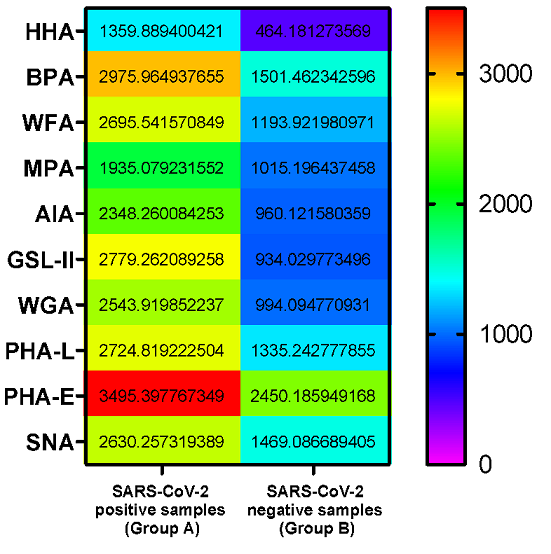
GlycoDIAG’s GLYcoPROFILE® technology clearly indicated the glycan differences between SARS-CoV-2-positive and -negative samples.
BPA and PHA-E were able to discriminate the control group from SARS-CoV-2-positive samples, with values around or higher than 3000. The BPA recognizes GalNAc-containing glycans, while PHA-E binds to bi-antennary complex N-glycans. In addition, another group of lectins, including WFA (binds to LacdiNAc), GSL-II (binds to agalacto) and PHA-L (binds to tri/tetra antennary complex N-glycan), were also distinguishing for SARS-CoV-2-positive samples. The HHA lectin was confirmed as a negative reference lectin.

Interactions between thrombopoietin (TPO) receptor MPL and a marine sponge-derived lectin

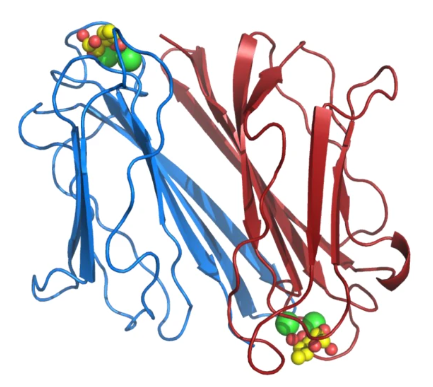
A group from Graduate School of Fisheries Sciences, Hokkaido University, Hakodate, Japan, etc. has reported about interactions between thrombopoietin (TPO) receptor MPL and a marine sponge-derived lectin, thrombocorticin (ThC).
https://www.nature.com/articles/s41467-022-34921-2

It has been reported that a marine sponge-derived 14-kDa protein, ThC, as a potent agonist of MPL.
In this study, the three-dimensional structure of ThC was elucidated as a fucose-binding lectin, and also it was shown that the MPL activation was induced by its binding to a fucosylated glycan on MPL.


Dimer structure of rThC in complex with Ca2+ (green ball) and fucose (ball-and-stick model, yellow: carbon, red: oxygen)

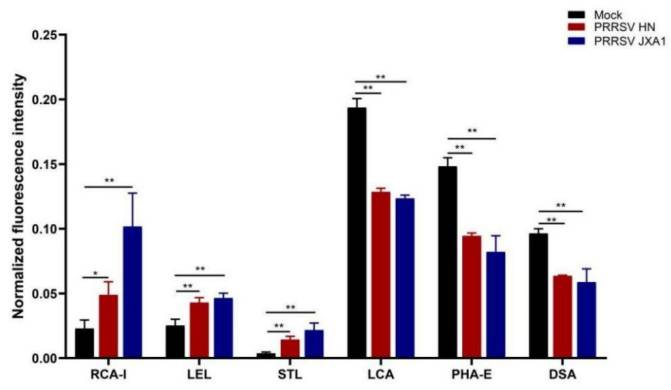
Changes in cell surface glycans after viral infection by lectin microarrays: Porcine infectious diseases caused by highly pathogenic porcine reproductive and respiratory syndrome virus

A group from Beijing Key Laboratory of Traditional Chinese Veterinary Medicine, Animal Science and Technology College, Beijing University of Agriculture, Beijing, China has reported about changes in glycosylation of porcine pulmonary microvascular endothelial cells due to highly pathogenic porcine reproductive and respiratory syndrome virus infection.
https://www.ncbi.nlm.nih.gov/pmc/articles/PMC9695484/

Porcine reproductive and respiratory syndrome virus (PRRSV) has been widespread around the world and has seriously jeopardized the pig industry for decades, mainly causing severe reproductive disorders in sows and respiratory symptoms in piglets. However, its pathogenesis has not been fully clarified so far, causing its prevention and control to remain a great challenge.

To understand the effects of highly pathogenic porcine reproductive and respiratory syndrome virus (HP-PRRSV) infection on the surface carbohydrate chains of PPMVECs, they were infected with HP-PRRSV HN and JXA1 strains in this study. Then, their cell surface glycan profiling was analyzed by lectin microarrays.

It was found that HP-PRRSV infection of PPMVECs significantly damages the cell surface structures, especially causing the decrease in complex N-glycans and the increase in poly-N-acetyllactosamine. This finding suggest that changes in cell surface carbohydrate chains may be an important factor causing the dysfunction of HP-PRRSV-infected PPMVECs.

Human Dectin-1 deficiency impairs macrophage-mediated defense against phaeohyphomycosis

A group from Fungal Pathogenesis Section and Immunopathogenesis Section, Laboratory of Clinical Immunology and Microbiology (LCIM), National Institute of Allergy and Infectious Diseases (NIAID), NIH, Bethesda, Maryland, USA, etc. has reported that human Dectin-1 deficiency impairs macrophage-mediated defense against phaeohyphomycosis.
https://www.ncbi.nlm.nih.gov/pmc/articles/PMC9663159/

Phaeohyphomycosis is an invasive fungal infection caused by dematiaceous fungi, which are characterized by melanin production and filamentous growth. Phaeohyphomycosis typically affects the subcutaneous tissues following traumatic inoculation and is treatable with antifungal therapy and/or surgical resection.

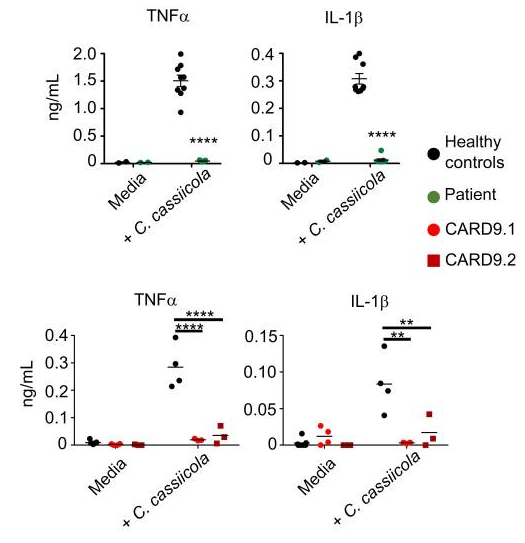
In this study, an index patient with severe phaeohyphomycosis caused by Corynespora cassiicola, a dematiaceous fungus of plants known to cause life-threatening infections in CARD9 deficiency is highlighted. This patient had biallelic deleterious mutations in CLEC7A, which encodes the CARD9-coupled receptor, Dectin-1. It was shown that Dectin-1 is critical for IL-1β and TNF-α production against this fungus by human immune cells, which enhances macrophage fungal killing. CARD9 is an immune adapter protein in myeloid cells involved in C-type lectin signaling and antifungal immunity.

17 additional unrelated patients with severe phaeohyphomycosis were also evaluated, and t was found that 12 out of 17 had deleterious CLEC7A mutations, which were associated with an altered Dectin-1 extracellular, β-glucan–binding, C-terminal domain, and impaired Dectin-1–dependent cytokine production.


showing proinflammatory cytokine responses to this fungus from the Dectin-1–deficient patient and from CARD9-deficient patients.

Diagnosis of Hepatocellular carcinoma (HCC) with using AFP and changes in IgG/IgM glycosylation

A group from Department of Laboratory Medicine, Shengjing Hospital of China Medical University, Shenyang, China, etc. has reported about diagnosis of Hepatocellular carcinoma (HCC) with using Lectin Microarrays.
https://www.ncbi.nlm.nih.gov/pmc/articles/PMC9634732/

A model combining changes in IgG glycosylaion detected by three lectins (EEL, MPL, and TC) and Alpha-fetoprotein (AFP) showed good diagnostic accuracy for HCC, an area under the ROC curve of 0.96 (P < 0.05), the sensitivity of 82.54%, and the specificity of 100%.

Another model combining changes in IgM glycosylaion detected by one lectin (DSL) and AFP showed an area under the curve of 0.90 (P < 0.05), sensitivity of 75.41%, and specificity of 100%.

A new therapeutic method focusing on inhibition of PD-L1 against Candida albicans

A group from Clinical Medicine Scientific and Technical Innovation Center, Shanghai Tenth People’s Hospital, Tongji University School of Medicine, China, etc. has reported about a negative role of PD-L1 expression on the host immune response, which inhibits neutrophil migration from the bone marrow into the infected sites for favoring immune escape of fungi infections.
https://www.ncbi.nlm.nih.gov/pmc/articles/PMC9652346/

Candida albicans is both a commensal and opportunistic fungal pathogen of humans. During systemic infection, C. albicans enters the bloodstream and disseminates throughout the body, causing the disease known as invasive candidiasis. The successful clearance of C. albicans from the host mainly relies on neutrophils by releasing proinflammatory cytokines, producing reactive oxygen species and anti-microbial peptides, and forming neutrophil extracellular traps.

PD-L1 is found to be expressed on the plasma membrane of immune cells, including neutrophils, B cells, dendritic cells, and macrophages. During C. albicans infection, β-glucans exposed on the cell wall of C. albicans play an important role in modulation of the host response. The C-type lectin receptor Dectin-1 (encoded by Clec7a gene) is the most important neutrophil pattern recognition receptor for the recognition of β-glucans.

In this study, it was demonstrated that activation of Dectin-1 by fungal β-glucans induced PD-L1 expression in murine and human neutrophils, and the upregulated PD-L1 inhibits neutrophil migration from the bone marrow into the infected sites through regulating their autocrine secretion of chemokines CXCL1 and CXCL2. This finding provides new insights that PD-L1 would function as a potent therapeutic target of neutrophil-based immunotherapy against fungal infections through regulating neutrophil release from the bone marrow. That is, either PD-L1 blockade or pharmacological inhibition of PD-L1 expression significantly increased neutrophil release from bone marrow to enhance host antifungal immunity.

Antifungal activity of bacterial isolates from healthy ginseng for the control of ginseng root rot disease (Fusarium oxysporum)

A group from Jilin Ginseng Academy, Changchun University of Chinese Medicine, Changchun, China, has reported about antifungal activity of bacterial isolates from healthy ginseng for the control of ginseng root rot disease (Fusarium oxysporum).
https://journals.plos.org/plosone/article/authors?id=10.1371/journal.pone.0277191

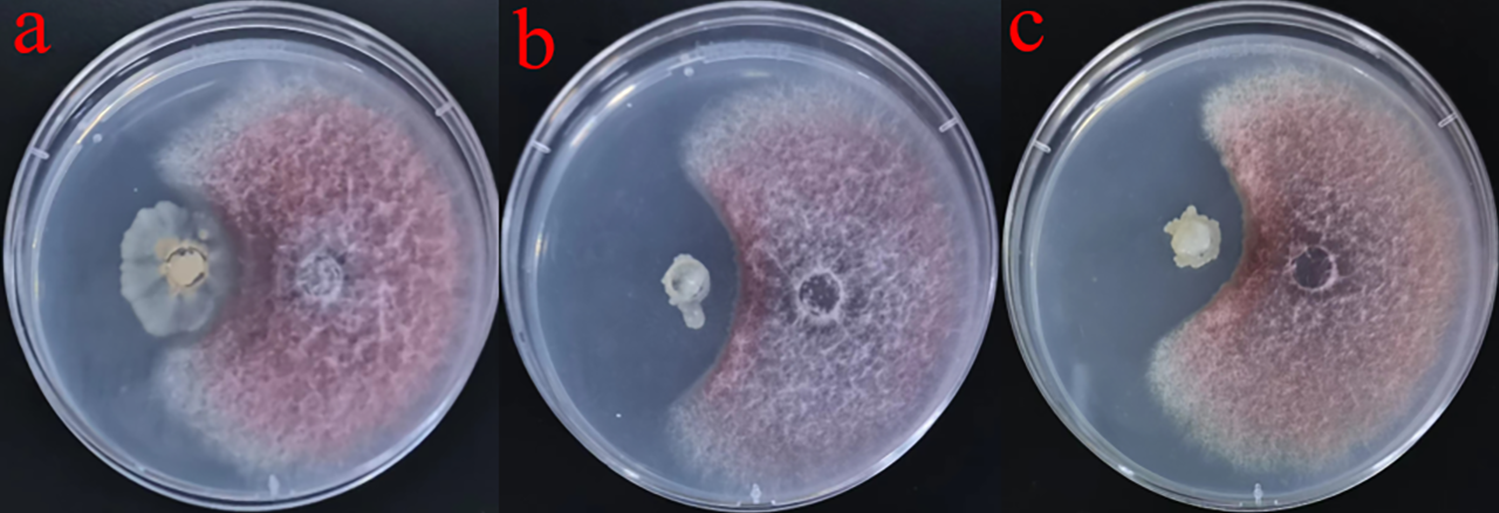
In total, 145 isolates were isolated from rhizosphere soil of Panax ginseng. Among these, three isolates, designated YN-42(L), YN-43(L) and YN-59(L) exhibited inhibitory activity against Fusarium oxysporum in vitro.


where,
a: Bacillus subtilis [YN-42(L)],
b: Delftia acidovorans [YN-43(L)], and
c: Bacillus polymyxae [YN-59(L)].

Powered by WordPress |Copyright © 2020 Emukk. All rights reserved