A human lectin microarray

A group from Department of Life Sciences, Imperial College London, London, United Kingdom has reported about human lectin microarray.
https://www.jbc.org/article/S0021-9258(24)02371-8/fulltext

A human lectin array containing 39 different human CRDs from 36 sugar-binding receptors representing 7 different structural groups has been developed.
The following is a list of 39 lectins clasified into 7 groups.
MBP, SP-A, SP-D, Colk1
MMR CRD4, Langerin, DC-SIGN, DC-SIGNR, Prolectin, LSECtin, Endo180 CRD2, Mincle, Dectin-2, BDCS-2, Dectin-1
ASGPR1, ASGPR2, MGL, SRCL
Galectin-1, Galectin-2, Galectin-3, Galectin-7, Galectin-4N, Galectin-4C, Galectin-8C, Galectin-9N, Galectin-9C
Siglec-1, Siglec-3, Siglec-5, Siglec-7, Soglec-9, Siglec-11
Intelectin-1, Intelectin-2
MMR-CR, Ficolin-1, Chl3-L2
A new approach which enables of accurately detecting Canser Stem Cells (CSCs)

A group from UMR INSERM 1308 CAPTuR, Faculty of Medicine, University of Limoges, Limoges, France has reported about a new approach which enables of accurately detecting Canser Stem Cells (CSCs).
https://www.nature.com/articles/s41416-024-02839-9

A combination of plant lectins (MIX: UEA-1 and GSL-I) was used as a new approach to detect CSCs from a heterogeneous non-small cell lung cancer (NSCLC) population.

It was demonstrated that the combination of those lectins recognizing glycosylated pattern exposed on CSCs were more efficient for detecting and sorting CSCs than CD133.
CD133 is know as a CSCs marker.

Galectin-8 alters non-canonical TGF-β response in CRC cells and suppresses CRC progression

A group from Genomics Research Center, Academia Sinica, Taipei, Taiwan has reported about a glycan-binding protein modulated the TGF-β-driven signaling and metastasis of colorectal cancer (CRC).
https://www.ncbi.nlm.nih.gov/pmc/articles/PMC11375092/

This study demonstrate that galectin-8 alters non-canonical TGF-β response in CRC cells and suppresses CRC progression, although Galectin-8 is not a canonical regand of TGF-β Receprtor.

In detail, in the absence of galectin-8, TGF-β binds to type II TGF-β receptor (TβRII), thereby promoting epithelial-mesenchymal transition (EMT).
In the presence of galectin-8, galectin-8 binds to TβRII through galactosylaeted-glycans, resulting in a decrease of TGF-β signaling-mediated EMT.
It was also shown that galectin-8 expression is downregulated during CRC progression.
The expression of galectin-8 is significantly lower in T4 stage than that in T1 stage.

The recognition of hypermucoviscous Klebsiella pneumoniae clinical isolates by innate lectins

Department of Biological Physical Chemistry, Instituto de Química Física Blas Cabrera, Consejo Superior de Investigaciones Científicas, Madrid, Spain has reported about the recognition of hypermucoviscous Klebsiella pneumoniae clinical isolates by innate immune lectins of the Siglec and galectin families.
https://www.ncbi.nlm.nih.gov/pmc/articles/PMC11324429/

Klebsiella pneumoniae is an opportunistic bacterium that frequently colonizes the nasopharynx and gastrointestinal tract and can also cause severe infections when invading other tissues, particularly in immunocompromised individuals.
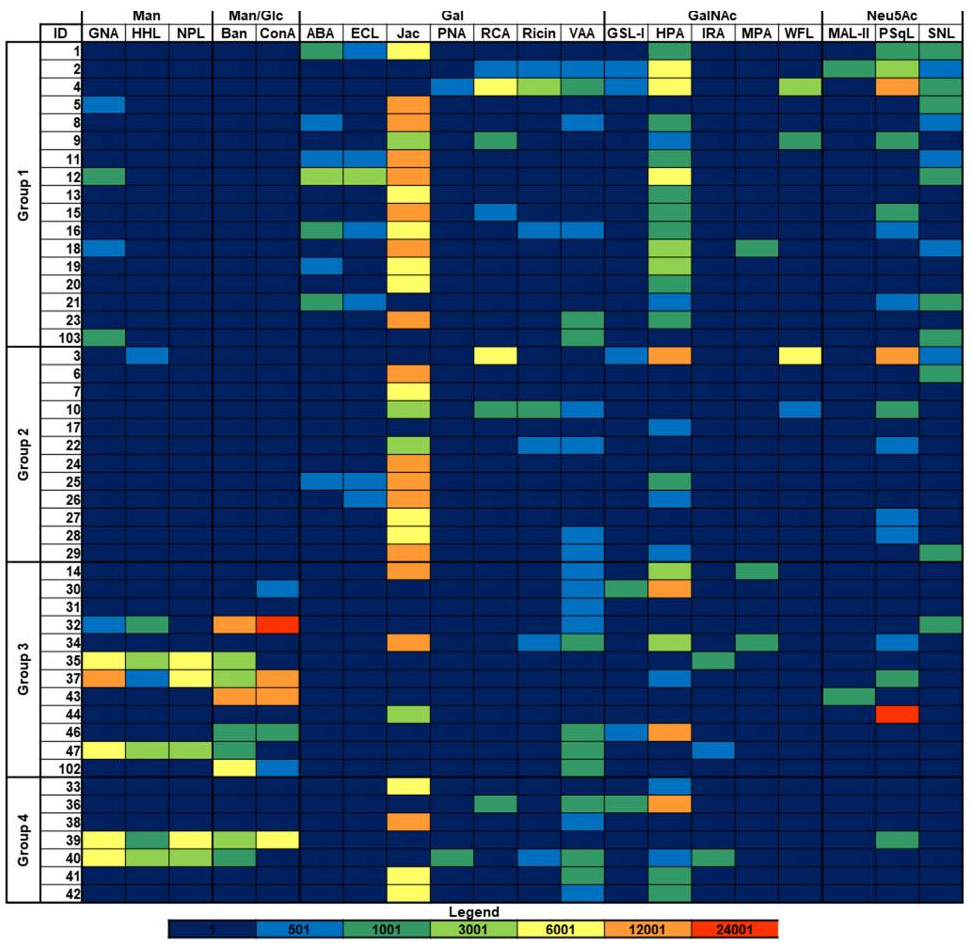
There were striking differences in the recognition of those bacteria by sialic acid-, galactose- and mannose-specific lectins as shown below.

Extracellular Polymeric Substances (EPS) produced by bacteria used in biological wastewater treatment

A group from Department of Biotechnology, Delft University of Technology, The Netherlands has reported about extracellular polymeric substances (EPS) produced by bacteria used in biological wastewater treatment.
https://pubs.acs.org/doi/epdf/10.1021/acsestwater.4c00247

Unlike DNA replication or protein translation, glycan biosynthesis is not directed by a preexisting templatemolecule. The production of glycans is decided by a few factors: the biosynthetic machinery, the available nucleotidesugars, and signals from the intracellular and extracellular environment.
Thus, the presence of glycans is dynamic and is influenced by both geneticand environmental factors. Therefore, under such conditions, it is tremendously challenging to study the glycan composition in EPS.

Typically, approaches for studying glycoproteins in environ-mental samples involve identifying individual glycan structuresand further characterizing the proteins with mass spectrometry.
On the other hands, lectin microarrays offer a high throughput examination of the glycans on the proteinsurfaces, enabling a broader screening of a possible proteinglycosylation pattern.
So, they concluded that combining both approaches can provide acomprehensive understanding of glycoproteins, bridging the gapbetween structural characterization and functional implications

Roles of Glycan and Lectin interactions in Embryo Attachment

A group from Shenzhen Key Laboratory of Metabolic Health, Center for Energy Metabolism and Reproduction, Shenzhen Institute of Advanced Technology, Chinese Academy of Sciences, China has reported about roles of glycan and lectin interactions in embryo attachment.
https://www.sciencedirect.com/science/article/pii/S2090123224003060?via%3Dihub

Althopugh the interaction between trophoblastic L-selectin and endometrial sLeX has been reported as a glycosylation-dependent adhesion mechanism underlying embryo implantation, it was also found that Siglec-6 expressed in the trophectoderm of human embryos play a key role in facilitating embryo attachment via recognizing the sTn-covered receptive endometrium.

Changes in IgG glycosylation patterns for antiphospholipid syndrome (APS) patients with lectin microarray

A group from Department of Rheumatology and Clinical Immunology, Chinese Academy of Medical Sciences & Peking Union Medical College, Beijing, China has reported about changes in IgG glycosylation patterns for antiphospholipid syndrome (APS) patients with lectin microarray.
https://onlinelibrary.wiley.com/doi/10.1111/sji.13366

It was found that IgG complexes from APS patients exhibited a significantly elevated exposure of GalNAc residues compared with healthy controls and disease controls. This suggests that elevated GalNAc on IgG plays a role in the progression of APS. However, compared with N-linked glycosylation, the effects of O-glycosylation on IgG structure and function remain to be elucidated.

Detecting Colorectal Cancer from Glycosylation Profiling Analysisi of Exosomes

A group from State Key Laboratory of Electroanalytical Chemistry, Changchun Institute of Applied Chemistry, Chinese Academy of Sciences, Changchun, China has reproted about Lectin microarray based glycan profiling of exosomes.
https://www.sciencedirect.com/science/article/abs/pii/S0003267024006202?via%3Dihub

In this styudy, the differential analysis of glycosylation on the surface of exosomes between from three olorectal cancer cell lines (SW480, SW620, HCT116) and from one normal colon epithelial cell line (NCM460) has been done by using a lectin microarray. As a result, it has shown that UEA-I lectin could be used to detect aberant glycosylation of exosomes derived from SW480 cells.

And further, in this experiment, the limit of detection (LOD) of UEA-I lectin microarray was calculated to be as low as 2.7 × 10⁵ extracellular vehicles/mL.

Surface Glycans of Microvesicles Derived from Endothelial Cells

A group from Shemyakin and Ovchinnikov Institute of Bioorganic Chemistry RAS, Moscow, Russia has reported about surface glycans of Microvesicles derived from endothelial Ccells.
https://www.ncbi.nlm.nih.gov/pmc/articles/PMC11171894/

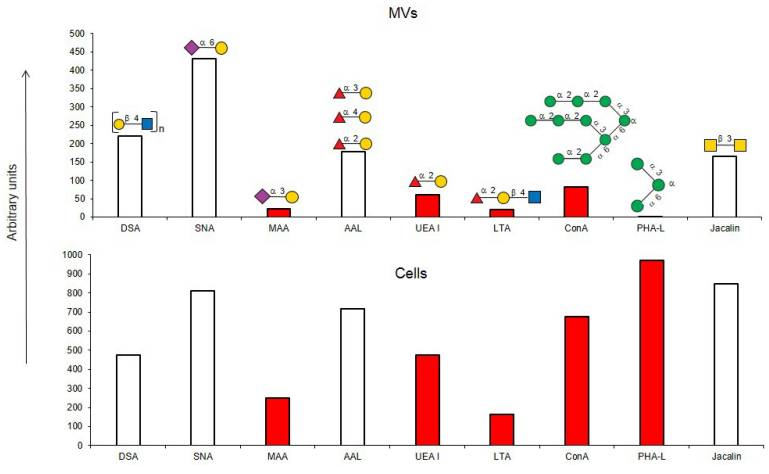
As shown below, it is clearly shown that the surface glycans of MVs are dominated by α2-6-sialylated forms as N-glycans and the level of some Man-containing glycans are significantly decreased in MVs, comparing surface glycans of MVs and those of Cells.

Glycosylation of adeno-associated virus (AAV) used for gene therapy was investigated using Lectin microarrays

A group from Department of Biotechnology, Graduate School of Engineering, Osaka University, Osaka, Japan has reported about glycosylation of recombinant adeno-associated virus serotype 6 (rAAV6) which is used for Gene therapy.
https://www.ncbi.nlm.nih.gov/pmc/articles/PMC11107246/

Glycosylation of recombinant adeno-associated viruses (rAAVs) that are used for gene theraphy has been evaluated by Lectin microarrays.
It was found that rAAV6 was mainly O-glycosylated with the mucin-type glycans, O-GalNAc (Tn antigen), and mono- and di-sialylated Galβ1-3GalNAc (T antigen).

The purpose of this study was to see if glycosylation of rAAV6 can affect gene therapy safety in terms of immunogenecity and overall transduction efficacy of this method.
However, unfortunately, this study still could not evaluate the direct influence of mucin-type O-glycans on transduction efficiency.

Powered by WordPress |Copyright © 2020 Emukk. All rights reserved