A group from Memorial Sloan Kettering Cancer Center, New York etc. has reported on the development of therapeutic agents targeting Galectin-3 for breast and ovarian cancers.
https://www.nature.com/articles/s41598-021-82686-3
In ovarian and breast cancers, mucin named MUC16 with CA125 epitope is highly expressed. Mucins are strongly glycosylated with O-glycans, and the glycan chains are sometimes stretched by adding a poly LacNAc chain to the terminal. Galectin-3 (Gal-3) has affinity to the poly LacNAc, hence Gal-3 could bind to MUC16 via such glycans. Galectin family has various functions, and MUC16 is closely related to cancer cells and is considered to be related to cancer growth and metastasis.
Using a monoclonal antibody (14D11) against Gal-3, the authors evaluated the inhibitory effects of Gal-3 on ovarian and breast cancers in vitro and in vivo. The Kd value for Gal-3 and LacNAc binding was ~0.2mM, and the Kd value for Gal-3 and 14D11 was ~14.6nM. Therefore, it turns out that 14D11 has stronger affinity about 13,000 times.
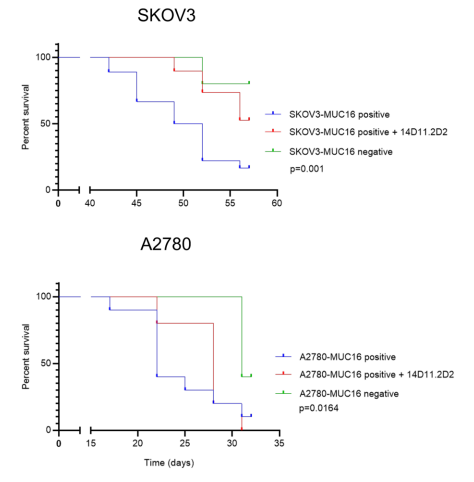
Two ovarian cancer cell lines (A2780, SKOV3) with high expression of MUC16 were transplanted into mice and the effects of 14D11 administration were compared with survival rates.
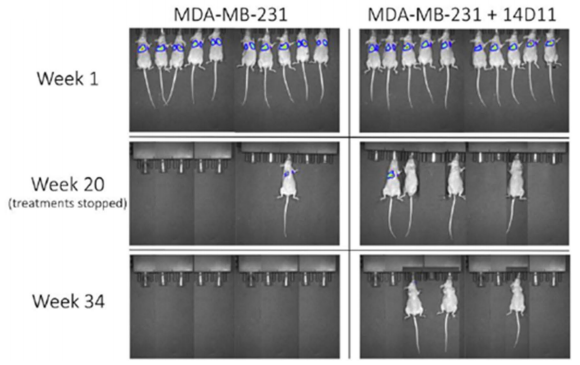
In addition, breast cancer cells (MDA-MB-231) were transplanted into mice and the effects of 14D11 administration were compared as below. These experimental results show that inhibition of Gal-3 can reduce cancer growth significantly.