Fc-fusion ivermectin-containing nanoparticle drug that can be administered orally for the new coronavirus (COVID-19)

Ivermectin, an antiparasitic drug, has been known to have antiviral effects, too. The mechanism of action is thought to be because inhibiting nuclear transport proteins such as an importin prevents the transport of viral proteins into the nucleus.
Ivermectin itself is toxic, and EC50 is 1 to 10 mM. When ivermectin is administered to the human body with 150 µg/kg of dose, the concentration in plasma is only 9 to 75 ng/mL, and the concentration is too low to be effective.
Therefore, the following group has verified the effect of a therapeutic agent (Fc-fusion ivermectin-containing nanoparticles that can be administered orally: T-Fc-IVM-NPs) that enables intestinal absorption of T-Fc-IVM-NPs via interaction between FcRn receptors expressed on gut epithelial cells and Fc on ivermectin-containing nanoparticles.
https://pubs.acs.org/doi/10.1021/acsptsci.0c00179

At this stage, although it was an in vitro experiment using HEK293 infected with the new novel coronavirus (SARS-CoV-2), it is said that the expression of ACE2 and the expression of S-protein were suppressed by administering T-Fc-IVM-NPs. In addition, this method can be expected to be effective against other viruses.

It’s good, isn’t it?
Conditions of the new coronavirus (COVID-19) can be mimicked by a SARS-CoV-2 protein cocktail (S, N, P-protein)

A group of La Paz University Essential, Spain has suggested a treatment based on the novel coronavirus (COVID-19) symptoms that can be completely mimicked by a protein cocktail of SARS-CoV-2.
https://pubmed.ncbi.nlm.nih.gov/33283062/

In patients with COVID-19, inflammation and cytokine storms are induced, and il-1β, IL-6, and TNF-α are known to be highly expressed. This early stage can be explained by excessive activation of monocytes and macrophages. In the later stages of COVID-19, adaptive immunity plays a critical role, and in severe patients, lymphocytes are significantly reduced.

Blood cells obtained from healthy people was incubated with SARS-CoV-2 S-protein, N-protein and P-protein cocktails and developed a phenotype that mimics the COVID-19 condition. For example, in monocytes, HLA-DR, the signal path for antigen presentation, was reduced, and PD-L1, a immune checkpoint ligand, was highly expressed.
From these results, it was suggested that the use of inhibitors (antibodies) for immune checkpoint molecules could lead to effective treatment. Actually, a clinical trial using camrelizumab (PD-1 antibody) is in progress.

Expect progress.

Simplified sample preprocessing of RT-PCR in novel coronavirus (SARS-CoV-2) detection: heat treatment only

RT-PCR is the Gold Standard for testing for covid-19. Samples are taken from the nasal cavity with cotton swabs, nucleic acids are extracted by pre-treatment, and then RT-PCR is performed, but reagents and consumables are running out due to the increase in the number of tests worldwide.
There is a report of how this preprocessing process can be simplified as follows.
https://journals.plos.org/plosone/article/authors?id=10.1371/journal.pone.0243266

As a result, a sample of 20uL to 40uL was heat treated at 95°C to 98°C for 2 to 20 minutes to obtain good RT-PCR results.
The RT-PCR kit evaluated were
ABI TaqMan fast virus 1-Step RT-qPCR kit,
Meridian Bioscience Fast 1-Step RT-qPCR kit.

However, when the sample was suspended using UTM Viral Transport COPAN, this method failed to produce any detectable signal.
The cause is unknown because the composition of the reagent is not disclosed. So, depending on the combination of reagents used in the RT-PCR Kit, it seems that a simplified pre-treatment of heat treatment may not work properly.

A disposable qPCR chip for detecting the new coronavirus (COVID-19)

A group of  Imperial College London has reported a prototype of a disposable new coronavirus (COVID-19) detecting qPCR chip. Of course, this chip can also be used for other infections.
https://www.nature.com/articles/s41467-020-19911-6

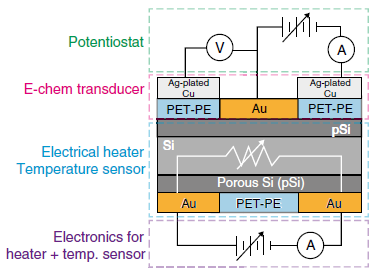
The chip has a very simple structure and is built on a Si substrate (the size of the chip is about 1 cm square). The cost when manufactured with a Si 4-inch wafer was about 40 yen/chip, so it will certainly be disposable.
The temperature control of the chip is done by controlling electric current flowing in the Si substrate, and the detection is performed electrochemically using methylene blue (MB) as a redox reporter. Since MB acts also as an intercalator of DNA, the electrochemical current changes when DNA is amplified.

Crowdfunding to elucidate the mechanism of the novel coronavirus (COVID-19)and develop therapeutic agents

I also participate in a project targeting elucidation of the mechanism of the sever disease of new coronavirus (COVID-19) and the development of therapeutic drugs.
We promote development of this project by making full use of our experience and wisdom in glycans and lectins.
Thank you for your continuous support on our activities.


https://readyfor.jp/projects/glycotechnica_covid19research/announcements/150515

Using CRISPR/Cas12a to detect new coronavirus (COVID-19:SARS-CoV-2): Sensitization effect adding Mn2+

CRISPR/Cas9 won the 2020 Nobel Prize in Chemistry about a week ago.
We have found several papers that used this technique as a high sensitive detection method for the new coronavirus. The following paper reports that detection using CRISPR/Cas12a could be further 13 times more sensitive by adding Mn2+.
https://www.ncbi.nlm.nih.gov/pmc/articles/PMC7536916/#advs2020-bib-0005

A brief description of the protocol is as follows:

  • Extract an RNA sample from a sample.
  • Make cDNA using reverse transcription, and amplify by PCR (dsDNA is made).
  • Pre-design crisper RNA (crRNA) using RNA sequences specific to the E protein of the new coronavirus.
  • Add Cas12a enzyme and crRNA to the dsDNA sample, the new coronavirus-specific sequence is cut out when it is in the sample dsDNA.
  • Thus, since the inhibitory interaction between the fluorescent probe and the quencher that have been incorporated in the PCR process is lost, the fluorescence comes out by applying the excitation light.

Of course, this fluorescence is read by a detector, but it can be confirmed by the eyes.
The addition of Mn2+ to this system increased the sensitivity by 13 times.

How to reduce cross-reactivity to other coronaviruses in the detection of new coronaviruses (SARS-CoV-2) using RT-PCR

RT-PCR is used as you know to test for suspected infection of the new coronavirus (SARS-CoV-2). Sensitivity and specificity are very important in testing, but there are some doubts as to how high the generally implemented RT-PCR could detect SARS-CoV-2 without cross-reactivity to other coronaviruses including influenza viruses. Therefore, the following groups have reported a novel methodology for improving the specificity of SARS-CoV-2 detection without sacrificing sensitivity.
https://www.mdpi.com/2075-4418/10/10/775

As the methodology, they adopted the followings, (1) in the domain of structural protein of SRAS-CoV-2, design dual-target PCR primers targeting on coding region of the accessory and envelope proteins (ORF3ab-E primers) and that of the capsid protein (N primers), and (2) use a peptide nucleic acid (PAN) designed to target on the N region as a blocker of PCR reaction.

Peptide nucleic acids are artificial compounds in which the deoxyribose phosphate backbone is replaced by a pseudo-peptide polymer to which the nucleobases are linked, and the binding affinity for target DNA and RNA is remarkably increased by nearly 1000 times, and therefore, it does not act as a primer but act as an inhibitor of PCR.

As a result, cross-reactivity to other coronaviruses and influenza viruses disappeared completely, and the detection rate of SARS-CoV-2 was 100% for ORF3ab-E and 82.6% for PNA-N.

About infection inhibitors of the new coronavirus (SARS-CoV-2) as its therapeutic drugs: Are inhibitors on furin and transmembrane protease serine 2 etc. effective?

The S protein of the new coronavirus (SARS-CoV-2) is divided into S1 sites that bind to the host receptors and S2 sites for membrane fusion. The boundary site of this S1 site and S2 site has a furin cleavage site, and there is a target domain of transmembrane protease serine 2 (TMPRSS2) in the S2 site. The following research has been reported that the use of inhibitors on those proteases may be able to reduce the infection of the new coronavirus.
https://linkinghub.elsevier.com/retrieve/pii/S2211-1247(20)31243-2

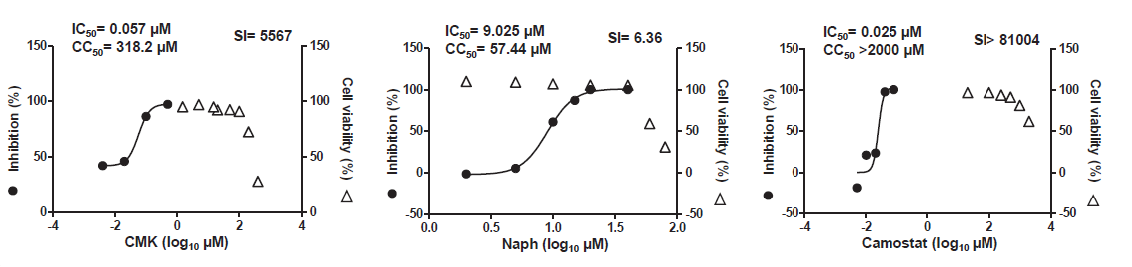
decanoyl-RVKR-chlorometylketone (CMK) for a furin inhibitor, camostat for a TMPRSS2 inhibitor, as well as naphthofluorescein which inhibits RNA replication, were studied. VeroE6 cells are used for the experiments.


Obtained efficacy and toxicity were as follows; the 50% inhibitory concentration (IC50) was 0.057 μM for CMK, 9.025 μM for naphthofluorescein, and 0.025 μM for camostat. The 50% cytotoxic concentration (CC50) was 318.2 μM for CMK, 57.44 μM for naphthofluorescein, and 2,000 μM for camostat. The resulting selection index is 5,567 for CMK, 6.36 for naphthofluorescein, and 81,004 for camostat.

Note that there is a difference among these inhibitors, CMK and camostat prevent the initial infection of the virus, and naphthofluorescein prevents the replication of the virus. We look forward to further consideration as a lead compound for the development of therapeutic drugs in the future.

To suppress infection with the new coronavirus (SARS-CoV-2), pineapple intake will be GOOD.

The Univ. of Nebraska Medical Center group has reported a research finding that bromelain extracted from pineapples (enzyme classified as a cysteine protease in proteolytic enzymes) is effective in suppressing infection with the new coronavirus (SARS-Co-2).
https://www.biorxiv.org/content/10.1101/2020.09.16.297366v1


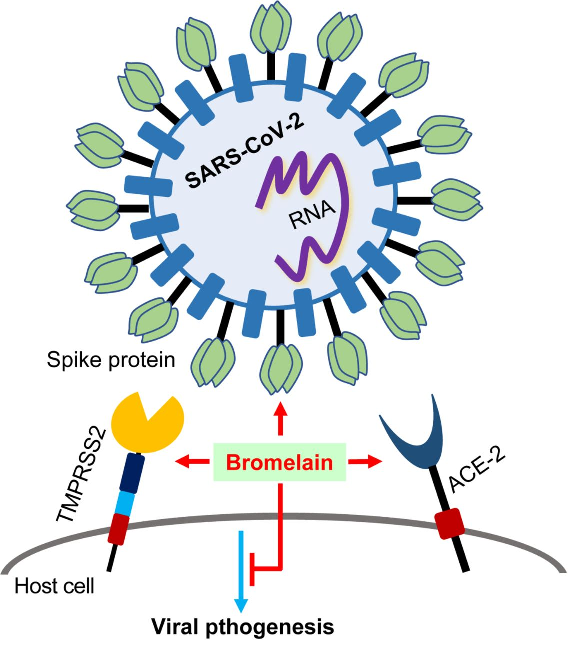
Bromelain targets angiotensin-converting enzyme 2 (ACE2), type II membrane-penetrating serine protease (TMPRSS2) and SARS-CoV-2 S-protein, and thereby suppresses SAS-CoV-2 infection. Because bromelain is well absorbed through digestive organs and maintains its biochemical activity in the body, it is said that ingesting pineapples rich in bromelain will suppress infection with the new coronavirus (SARS-CoV-2).

Powered by WordPress |Copyright © 2020 Emukk. All rights reserved